Big threats and empty hands
By Fatemeh Kavand
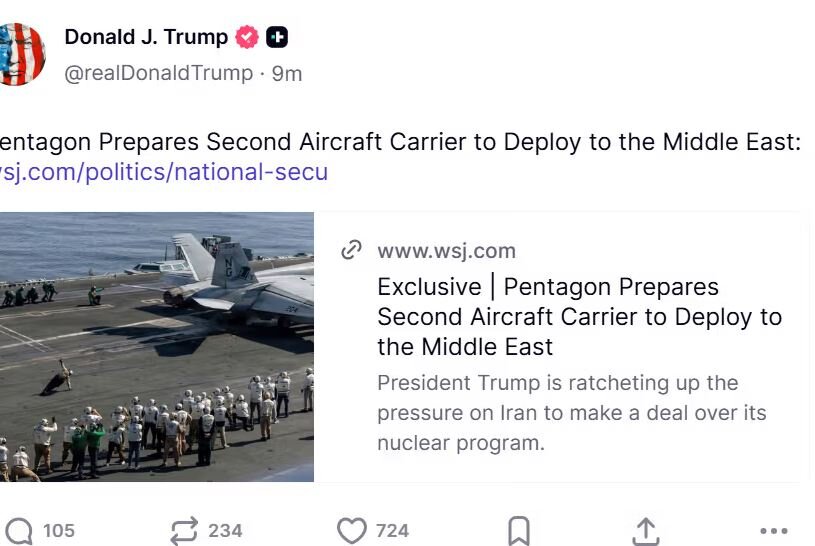
Renewed moves by the United States and Israel against Iran have once again inflamed the regional media landscape. From the repositioning of military equipment to the escalation of threatening rhetoric, everything points to mounting psychological pressure. But behind the noise, what reality lies hidden, and which way has the balance of power tilted?
In recent weeks, American and Israeli officials have once again hardened their tone against Iran. The deployment of certain military assets in the region, along with the circulation of threatening messages by Western political figures, has shaped the news cycle. Mainstream media outlets, by highlighting the possibility of direct confrontation, have sought to portray an imminent clash.
Yet a closer look at political and on-the-ground trends suggests that these moves are less a prelude to concrete action and more an attempt to restore lost deterrence. Experience in recent years has shown that whenever maximum pressure campaigns have failed to deliver results, verbal threats have tended to intensify.
In the military and security arena, any direct confrontation with Iran has been met with reciprocal and costly responses in recent years. Even Western analysts acknowledge that Iran’s deterrent capabilities have strengthened in recent years, and that any conflict could expand the scope of the crisis across the region.
Domestically, efforts to transform limited unrest into a widespread crisis did not unfold as external planners had anticipated. Iran’s political structure maintained control, and even foreign influence networks suffered setbacks. These failures have drained significant political capital from the opposing camp.
At the international level, political pressure campaigns against Iran’s allies have also fallen short of expectations. Many countries have chosen to act in accordance with their national interests rather than align themselves with costly geopolitical blocs.
In this context, the escalation of threatening propaganda can be seen as an effort to rebuild an image of power. This strategy appears to pursue two goals: first, creating psychological pressure to gain leverage at negotiating tables; and second, reassuring domestic audiences who increasingly question the costs of foreign policy decisions.
The use of harsh rhetoric and visible military movements is part of this broader deterrence game. The difference today, compared to a decade ago, is that regional public opinion—and even segments of Western elites—are more aware of the heavy costs of a large-scale conflict. The energy crisis, the war in
Ukraine, and economic instability have reduced the global capacity to absorb another shock.
At the same time that rhetorical tensions are rising, controversial revelations and cases, such as the Epstein affair, have resurfaced in American political discourse. Some analyses link these developments to internal power struggles and pressure from influential lobbying groups. Within this framework, an aggressive foreign policy can serve as a tool to shift the media agenda and redirect public attention.
Another scenario assumes that projecting instability or unpredictability is a tactic designed to intimidate the opposing side and extract concessions without entering an actual war. Others argue that these developments are less about Iran and more rooted in deep political divisions within the United States itself.
Regardless of these scenarios, one fact remains clear: any direct military action against Iran would carry far-reaching regional consequences. Energy security, shipping routes, and global market stability would be swiftly affected. Moreover, chain reactions among regional actors could expand the crisis beyond initial projections.
From a domestic perspective, experience has shown that external threats generally lead to greater internal cohesion within Iran. Under such conditions, assumptions of rapid fragmentation or collapse are inconsistent with social and political realities.
Even more extreme scenarios—such as the assassination of high-ranking figures—appear highly risky and unlikely, given the regional repercussions and the reactions of major powers. No actor would easily accept responsibility for igniting a sweeping crisis in West Asia.
In the end, the increase in threats appears less a sign of readiness for decisive action and more an attempt to manage perceptions and shape narratives. The United States and its allies operate in an environment where the costs of risky decisions far outweigh potential gains. What stands out today is not the prelude to an inevitable confrontation, but rather a war of narratives and psychological operations.
Leave a Comment